
How Amish Build Houses Without Power Tools
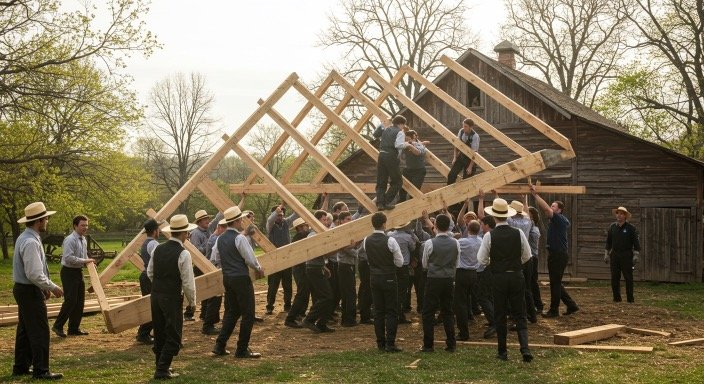
When you picture the Amish, you probably imagine horse-drawn buggies, neatly kept farms, and families dressed in simple clothing. But another image that captures people’s imagination is the sight of dozens of Amish men working side by side, raising the wooden frame of a house or barn without the hum of a single power tool. The silence—broken only by the sounds of saws, hammers, and voices—feels like stepping back in time.
So how do the Amish manage to construct entire homes, often large and complex, without electricity or modern machinery? The answer is rooted in tradition, faith, and an incredible reliance on community cooperation. Exploring how Amish build houses without power tools not only helps us understand their way of life but also gives us a new appreciation for the value of patience, precision, and teamwork.
( source: Amish America – Amish Homes)
How Amish Build Houses Without Power Tools
Why Amish Avoid Power Tools
The Amish way of life is guided by the Ordnung, a set of unwritten rules that govern behavior, dress, technology use, and social interactions. According to these values, relying too much on modern technology creates a separation between people and their community, while also increasing dependence on the outside world.
Electricity, in particular, is tied to the “English” (non-Amish) lifestyle. By avoiding it, Amish families keep their households grounded in simplicity. This restriction extends naturally into construction. Instead of nail guns, table saws, or electric drills, Amish carpenters reach for hand tools, air-powered machines, or alternative energy sources. Their buildings are more than just homes—they are symbols of devotion, humility, and independence.
How Amish Build Houses Without Power Tools
Hand Tools at the Center of Amish Carpentry
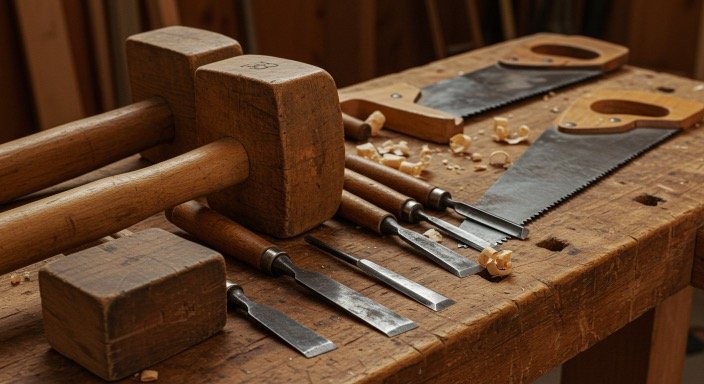
The Amish toolbox looks like something from your grandfather’s workshop. Every tool requires physical effort, making the carpenter deeply connected to the wood. Hand tools not only slow down the work but also allow for precision and quality that machines sometimes sacrifice for speed.
Some of the most common tools include:
- Crosscut and rip saws – for cutting beams, planks, and boards.
- Chisels and mallets – used in joinery and detailed woodworking.
- Hand planes – to smooth rough surfaces and bring out the grain of the wood.
- Augers and braces – the manual equivalent of drills.
- Levels and squares – to ensure accuracy in construction.
These tools demand skill, stamina, and patience, but they also give the carpenter a sense of pride. Every stroke of the saw or chisel leaves a human touch that no power tool can replicate.
(source: Fine Woodworking)
How Amish Build Houses Without Power Tools
Barn Raising: A Symbol of Community Power
One of the most iconic images of Amish life is the barn raising. Entire communities come together, sometimes hundreds of people, to construct a barn in just one day. While it may seem impossible without power tools, teamwork makes it possible.
During a barn raising:
- Men handle the framing and heavy lifting.
- Women prepare meals to keep workers nourished.
- Children run errands, fetch water, or deliver tools.
Every beam and post is cut by hand, and large groups of men lift them into place in unison. The barn is a communal effort, not just a personal project, and the speed comes from cooperation rather than machines. It’s the ultimate example of how Amish build houses without power tools: by substituting machinery with manpower and community spirit.
Alternative Energy: Not as Simple as It Seems
While Amish families avoid connecting to the power grid, that doesn’t mean they reject all forms of energy. Some groups use diesel generators, compressed air systems, or even solar panels to operate tools in limited ways. These exceptions vary by community.
- Air-powered tools (pneumatics): Instead of plugging in an electric drill, Amish builders may use a pneumatic drill powered by compressed air.
- Generators for sawmills: While you won’t find electric saws on-site, small generators might be used in sawmills to prepare lumber.
- Solar panels: In more progressive Amish districts, solar energy is used for lights or small appliances.
These choices show that Amish life is not about rejecting technology entirely but about controlling it. By using selective alternatives, they keep technology from becoming the master of their lives.
(source: National Geographic)
How Amish Build Houses Without Power Tools
Traditional Joinery: Strength Without Nails
Another fascinating aspect of Amish construction is their reliance on joinery techniques that have been around for centuries. Instead of depending on nail guns, they use methods such as:
- Mortise-and-tenon joints: Slots cut into one beam to hold another snugly.
- Dovetail joints: Angled cuts that lock wood together.
- Wooden pegs: Used instead of metal fasteners.
These techniques create structures that are incredibly durable. In fact, many Amish-built barns and homes stand for generations, a testament to the patience and skill invested. This old-world craftsmanship shows how building without power tools can still produce structures stronger than those built with modern shortcuts.
( source: Wood Magazine)
Quality Over Speed
Modern construction is often about deadlines and budgets. Contractors may rush projects, cutting corners with prefabricated materials and heavy machinery. Amish builders, however, view construction differently. Time is not the enemy—it’s part of the process.
An Amish-built house may take longer, but the outcome is a sturdy, carefully constructed home with incredible attention to detail. Clients who commission Amish homes often value the craftsmanship, knowing that each board was cut, shaped, and placed by hand. These homes are built to last, not just to meet short-term housing needs.
(source: Modern Farmer)
What We Can Learn from the Amish
Even if you never plan to build a house without electricity, there are valuable lessons in the Amish approach:
- Patience creates quality. Rushed projects rarely stand the test of time.
- Community matters more than machines. Shared effort reduces dependence on tools.
- Simplicity leads to durability. Sometimes the old ways really are better.
By focusing on quality, cooperation, and intentional living, the Amish offer a blueprint for more mindful building practices in a world dominated by speed and efficiency.
(source: Smithsonian Magazine)